

Loan size-ladder — does depth win with scale?#
PR #72 found deep monotone residual stacks beat shallow ones only on
loan, the largest dataset. This experiment isolates the cause: it holds
loan fixed and varies the training-set size N, tuning a deep (mixed
residual, depth ∈ {6, 10, 16}) and a shallow (mixed residual, depth ∈
[1, 4]) arm independently at each N, then reports
on the full held-out test set (10 seeds per arm; a fresh stratified N-subsample per seed, so the IQM band captures subsample and training variance). Method and protocol: Benchmark protocol and the design spec.
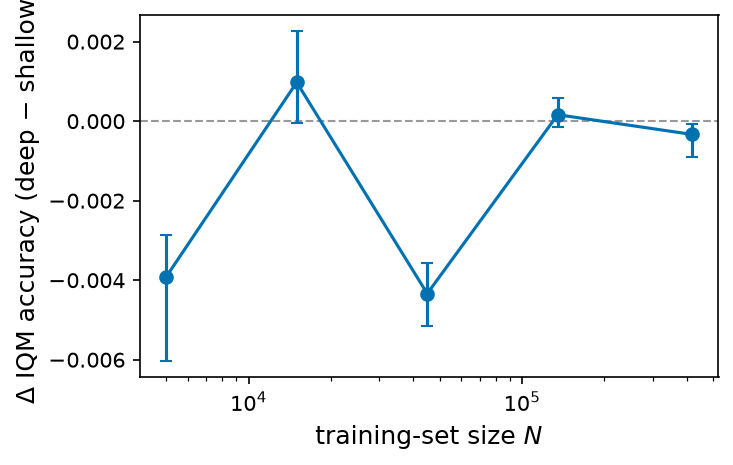
A vector copy (docs/_static/loan-size-ladder.pdf) is committed alongside for
LaTeX (\includegraphics{loan-size-ladder.pdf}).
Results#
Accuracy IQM over 10 test seeds per arm; L = effective monotone layers
(L = 2·depth + 2); Δ = IQM(deep) − IQM(shallow) with a 95% seed-bootstrap band.
N (train) |
deep IQM (L) |
shallow IQM (L) |
Δ [95% CI] |
|---|---|---|---|
5 000 |
0.6392 (14) |
0.6431 (8) |
−0.0039 [−0.0060, −0.0029] |
15 000 |
0.6454 (22) |
0.6445 (8) |
+0.0010 [−0.0000, +0.0023] |
45 000 |
0.6459 (34) |
0.6503 (10) |
−0.0043 [−0.0052, −0.0036] |
135 000 |
0.6480 (22) |
0.6478 (10) |
+0.0002 [−0.0001, +0.0006] |
full (~419k) |
0.6481 (14) |
0.6485 (10) |
−0.0003 [−0.0009, −0.0001] |
No seeds collapsed in any cell.
Interpretation#
Depth does not pay off with scale on loan. Δ(N) shows no dose-response: it
is negative or statistically indistinguishable from zero at every rung, and at
full size the deep arm is marginally worse (Δ = −0.0003). The deep arm keeps
selecting large depths (6–16) but they never beat a 3–4-layer shallow residual
stack.
This revises the earlier reading (PR #72) that “depth helps only on loan”:
that signal was a ≈0.001 IQM edge of a deep-residual stack over a
plain-shallow one — a comparison that conflates residual-vs-plain with
deep-vs-shallow. Isolating depth (residual vs residual, tuned independently per
N) erases it. The scaling hypothesis is not supported on loan.